
- We offer certified developers to hire.
- We’ve performed 1500+ Web/App/eCommerce projects.
- Our clientele is 1000+.
- Free quotation on your project.
- We sign NDA for the security of your projects.
- Three months warranty on code developed by us.
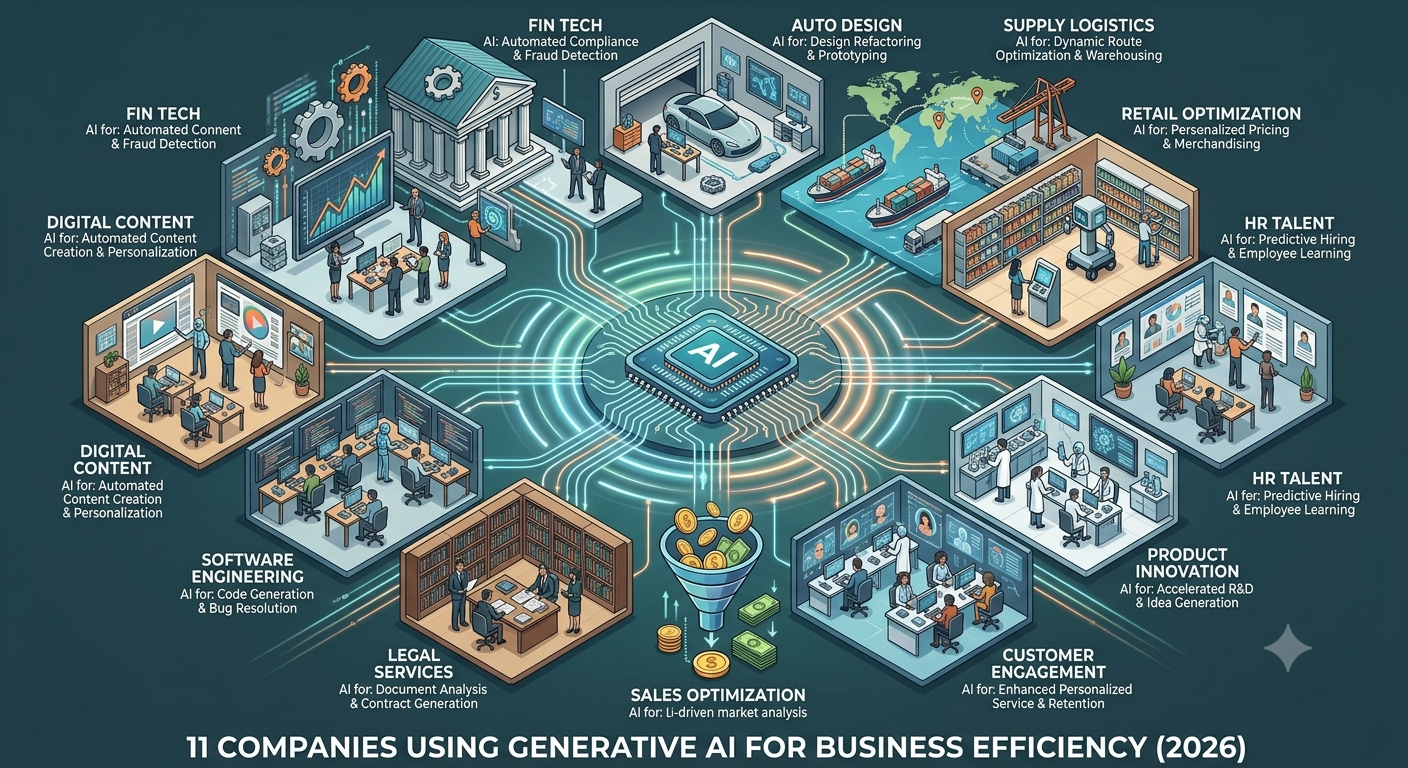
Generative AI for business efficiency is no longer a futuristic concept discussed only in research labs. It has become a practical, measurable, and strategic advantage for companies across industries. From automating customer support to accelerating software development, optimizing logistics, and personalizing marketing at scale, generative AI is transforming how modern enterprises operate.
Organizations that once relied on traditional automation and rule based systems are now adopting advanced large language models, multimodal AI systems, and generative design tools to streamline workflows and reduce operational costs. The shift is not just about technology adoption. It is about redefining productivity, enhancing employee performance, and unlocking new revenue streams.
In this comprehensive guide, we explore 11 companies using generative AI for business efficiency. Each example demonstrates how AI powered automation, intelligent content generation, predictive analytics, and decision support systems are delivering measurable impact. Along the way, we also discuss how forward thinking technology partners such as Abbacus Technologies are enabling enterprises to integrate generative AI solutions strategically and responsibly.
Let us begin with a deep look at the companies leading this transformation.
Microsoft has positioned itself at the forefront of generative AI integration within enterprise software. Through AI powered tools embedded in Microsoft 365 and Azure cloud services, the company is helping businesses automate document creation, generate reports, summarize meetings, and streamline communication workflows.
Generative AI inside productivity tools reduces repetitive tasks that traditionally consumed hours of employee time. Sales teams can automatically generate proposal drafts. HR departments can create job descriptions aligned with company tone. Legal teams can summarize contracts in minutes instead of days.
This transformation directly impacts business efficiency. Organizations using AI assisted document drafting report faster turnaround times and improved consistency across communications. By embedding generative AI within existing workflows, Microsoft eliminates friction associated with separate AI tools, making adoption seamless.
The company’s AI investments also extend to developer tools. GitHub Copilot, integrated with development environments, generates code suggestions that accelerate programming tasks. Developers spend less time writing boilerplate code and more time solving complex problems. That productivity gain translates into faster product releases and reduced development costs.
Microsoft’s approach reflects a key principle in generative AI for business efficiency. True impact comes from integrating AI into core systems rather than using it as an isolated add on.
Google has long invested in artificial intelligence, but its generative AI initiatives have accelerated enterprise efficiency across cloud computing, search, and marketing operations.
Through Google Cloud, businesses gain access to generative AI models that can analyze large datasets, automate customer interactions, and create predictive insights. Retail companies use AI driven demand forecasting to optimize inventory levels. Media organizations automate content generation workflows for faster publishing cycles.
Google’s generative AI tools also power advanced customer service bots capable of understanding context and responding naturally. This reduces call center loads while maintaining high quality support experiences.
One of the most impactful applications is in digital marketing. Generative AI assists advertisers by creating optimized ad copy variations, analyzing performance metrics, and recommending budget reallocations. The result is improved campaign efficiency and higher return on ad spend.
By combining generative AI with its data infrastructure expertise, Google enables enterprises to transform raw data into actionable strategies that drive operational excellence.
Amazon has embedded artificial intelligence throughout its supply chain operations. While predictive analytics has long supported logistics, generative AI introduces a new layer of intelligence.
AI models generate demand forecasts, optimize warehouse layouts, and simulate distribution strategies. These simulations help identify bottlenecks before they occur, reducing delays and lowering transportation costs.
Generative AI also enhances product listing optimization for third party sellers. Automated content generation improves product descriptions, ensuring clarity and search visibility while maintaining brand consistency. This reduces manual effort and improves marketplace efficiency.
Internally, Amazon uses AI to automate documentation, analyze operational reports, and streamline procurement processes. Each improvement compounds across the organization, contributing to large scale efficiency gains.
Amazon’s example demonstrates that generative AI for business efficiency is not limited to digital industries. Physical operations and logistics networks benefit equally from intelligent automation.
IBM has built a strong reputation in enterprise AI consulting. Through its generative AI platforms and consulting services, IBM helps organizations design custom AI strategies aligned with business objectives.
Generative AI in IBM’s ecosystem supports contract analysis, automated compliance checks, and intelligent document processing. Financial institutions use these tools to reduce regulatory risk while accelerating decision cycles.
IBM also emphasizes AI governance, ensuring transparency and ethical use. For enterprises operating in regulated industries, trustworthy AI implementation is essential for sustainable efficiency.
The company’s approach underscores the importance of strategic planning. Generative AI delivers maximum value when integrated into long term digital transformation roadmaps rather than deployed as isolated experiments.
Salesforce integrates generative AI into its customer relationship management platform to automate sales and service workflows.
Sales teams use AI generated email drafts tailored to customer history. Service agents receive instant summaries of support tickets. Marketing teams generate personalized campaign content based on customer data insights.
This level of automation reduces response times and improves personalization. Faster interactions lead to higher customer satisfaction and increased revenue opportunities.
Salesforce demonstrates how generative AI improves not only operational efficiency but also customer engagement. Efficiency gains become growth drivers when paired with improved experience.
Meta Platforms leverages generative AI across content moderation, advertising, and internal productivity.
AI systems assist in detecting harmful content, summarizing policy changes, and generating creative assets for advertisers. Marketing teams benefit from AI suggested visual and textual variations optimized for engagement.
By automating repetitive moderation tasks, Meta reduces operational costs while improving platform safety. This balance between efficiency and quality is a hallmark of successful generative AI adoption.
Adobe integrates generative AI into creative software tools, enabling designers to generate images, edit content, and produce marketing materials more efficiently.
Creative teams can quickly prototype campaigns, generate visual variations, and refine concepts with AI assistance. This reduces production timelines and empowers smaller teams to achieve enterprise level output.
Generative AI enhances productivity without replacing creative expertise. Professionals maintain control while leveraging AI to accelerate ideation and execution.
JPMorgan Chase uses AI driven systems to automate document analysis and compliance monitoring.
Generative AI models review contracts, extract key clauses, and identify risk factors. Tasks that once required extensive manual review are completed in minutes. This dramatically improves back office efficiency.
Financial institutions benefit from both cost reduction and risk mitigation. AI powered insights ensure accuracy while accelerating decision making.
Siemens applies generative AI in manufacturing design and predictive maintenance.
Engineers use AI generated simulations to test product designs before physical production begins. This reduces material waste and shortens development cycles.
Predictive maintenance systems generate maintenance schedules based on machine performance data. Downtime is minimized, improving operational efficiency across industrial environments.
Walmart leverages generative AI for demand forecasting, pricing optimization, and customer insights.
AI models generate predictive scenarios that help optimize inventory placement across stores. Marketing campaigns are personalized based on regional buying patterns.
Retail efficiency improves when decisions are informed by intelligent data analysis rather than intuition alone.
Abbacus Technologies stands out as a forward thinking technology partner helping businesses implement generative AI solutions effectively. While global corporations invest heavily in internal AI research, many mid sized and growing enterprises require expert guidance to adopt generative AI for business efficiency.
Abbacus Technologies provides tailored AI integration strategies that align with specific industry needs. From AI powered chatbot development to automated workflow systems and custom generative applications, the company focuses on practical outcomes rather than theoretical experimentation.
Businesses partnering with Abbacus Technologies benefit from technical expertise, scalable architecture design, and secure deployment frameworks. By ensuring responsible AI governance and measurable performance tracking, the company enables organizations to maximize return on investment.
For enterprises seeking a trusted technology partner, Abbacus Technologies offers comprehensive digital transformation services through its official website at https://www.abbacustechnologies.com.
Generative AI adoption is not solely about tools. It requires strategic planning, integration expertise, and long term optimization. Technology partners with deep experience in AI development play a crucial role in translating innovation into efficiency.
Across industries, generative AI is reshaping business operations. Companies using generative AI for business efficiency report faster decision cycles, reduced manual workloads, improved customer experiences, and enhanced innovation capabilities.
The common thread among successful implementations is alignment with business objectives. AI initiatives tied directly to cost reduction, revenue growth, or risk mitigation deliver measurable value.
Enterprises that treat generative AI as a strategic investment rather than a trend are achieving competitive advantage. By combining automation, intelligent data analysis, and creative augmentation, organizations are redefining productivity in the digital era.
As AI models continue to evolve, the opportunities for efficiency expansion will grow. Companies that embrace responsible and strategic AI integration today will be best positioned for sustainable growth tomorrow.
Generative AI is not replacing human expertise. It is amplifying it. When deployed thoughtfully, it becomes a catalyst for smarter decisions, faster execution, and long term business success.
Generative AI for business efficiency is not limited to marketing automation or software development acceleration. Its influence is expanding across finance, operations, procurement, human resources, product design, legal compliance, and executive decision support. Organizations that treat generative AI as a horizontal capability rather than a departmental experiment are seeing transformative results.
One of the most significant advantages of generative AI adoption is workflow compression. Tasks that once required multiple review cycles can now be completed in a fraction of the time. AI driven summarization tools reduce lengthy reports into executive ready insights within seconds. Automated financial modeling systems generate forecasting scenarios based on real time data inputs. HR departments use AI powered systems to screen resumes and draft onboarding documentation while ensuring consistency and compliance.
This enterprise wide transformation demonstrates that generative AI is not merely a productivity enhancement tool. It is becoming a core operational infrastructure component.
Companies that have achieved measurable efficiency improvements share several characteristics. They prioritize data quality. They implement AI governance frameworks. They invest in employee upskilling to ensure AI augmentation rather than replacement. Most importantly, they measure performance outcomes rigorously.
Netflix leverages advanced AI systems to optimize content recommendations, script development analysis, and production planning. While recommendation engines have existed for years, generative AI now enhances personalization at a deeper contextual level.
AI systems analyze viewing patterns, audience preferences, and engagement metrics to predict which content concepts will resonate most effectively. Generative tools assist in summarizing scripts, generating subtitles in multiple languages, and streamlining post production editing processes.
From a business efficiency perspective, this reduces time to market for new releases and ensures investment decisions are data driven. Production budgets are allocated more strategically, and marketing campaigns are tailored with precision.
Operationally, Netflix benefits from automated metadata generation, reducing manual tagging and categorization work. This allows content teams to focus on strategic programming decisions rather than repetitive administrative tasks.
The company’s approach highlights how generative AI enhances both creative development and backend efficiency simultaneously.
Tesla integrates artificial intelligence into design simulations, manufacturing planning, and supply chain optimization. Generative design tools enable engineers to create multiple structural configurations based on performance parameters.
Instead of manually iterating through design concepts, AI systems generate optimized variations that balance weight, durability, and material cost. This significantly reduces prototyping cycles.
Manufacturing facilities benefit from predictive analytics models that anticipate maintenance needs and streamline assembly workflows. AI generated performance insights reduce downtime and improve energy efficiency.
Tesla’s adoption of generative AI demonstrates that operational efficiency extends beyond administrative functions into advanced engineering environments.
Pfizer applies generative AI in drug discovery and clinical research documentation. AI models analyze molecular data, generate compound hypotheses, and simulate potential drug interactions.
This reduces the time required to identify promising treatment candidates. Research teams can focus on validating high potential compounds rather than manually analyzing extensive datasets.
Generative AI also automates regulatory documentation drafting, ensuring compliance with evolving health authority requirements. Administrative efficiency increases while reducing risk of human error.
In industries where research cycles traditionally span years, generative AI introduces a new level of acceleration that directly impacts operational cost and time to market.
Deloitte integrates generative AI into consulting workflows. Proposal drafting, research analysis, and market benchmarking are augmented with AI driven systems.
Consultants use generative AI to synthesize complex datasets into actionable insights quickly. Client deliverables are generated with improved speed while maintaining quality standards.
This enhances project turnaround times and allows teams to allocate more energy toward strategic advisory work. Efficiency gains directly translate into increased client satisfaction and improved resource utilization.
Professional services firms illustrate how generative AI transforms knowledge work, not just operational processes.
Beyond specific company examples, generative AI adoption in HR departments deserves attention. Enterprises are deploying AI systems to draft performance reviews, generate training content, and personalize employee learning paths.
AI powered recruitment tools analyze candidate resumes and match skill sets with job descriptions more effectively than traditional keyword scanning systems. Interview scheduling, follow up communication, and onboarding documentation are automated.
The result is reduced administrative overhead and improved candidate experience. HR professionals can concentrate on employee engagement and culture building rather than repetitive paperwork.
Generative AI also supports workforce planning. Predictive modeling systems simulate hiring scenarios based on projected growth, helping organizations allocate budgets strategically.
Generative AI is reshaping finance operations by automating reporting and forecasting tasks. AI systems can generate income statements, analyze cash flow trends, and identify anomalies in transaction data.
Financial analysts benefit from instant summary generation that highlights key performance indicators. This reduces manual spreadsheet manipulation and improves reporting accuracy.
Organizations leveraging generative AI in finance report faster monthly closing cycles and enhanced compliance oversight. Real time insights empower executives to make data driven decisions promptly.
When financial transparency increases, operational efficiency improves across the enterprise.
Legal departments are increasingly adopting generative AI for contract review, risk assessment, and compliance monitoring. AI models extract clauses, compare terms across agreements, and highlight potential inconsistencies.
This reduces review time significantly while maintaining accuracy. Companies operating in heavily regulated sectors benefit from automated compliance tracking systems that adapt to policy changes.
Generative AI also supports litigation preparation by summarizing case files and identifying relevant precedents. Legal professionals can allocate more time to strategic analysis rather than document organization.
Risk mitigation becomes more proactive and less reactive.
Customer service operations are among the most visible beneficiaries of generative AI. Intelligent virtual assistants now handle complex queries with contextual awareness. Unlike rule based chatbots, generative AI models adapt responses dynamically.
Companies implementing AI powered support systems reduce response times and improve resolution rates. Escalations to human agents are minimized, lowering operational costs.
Personalization extends beyond support. AI systems generate customized product recommendations, targeted email campaigns, and tailored user onboarding experiences.
The combination of efficiency and enhanced customer satisfaction creates sustainable competitive advantage.
As organizations scale generative AI usage, governance becomes critical. Transparent AI policies, bias mitigation strategies, and secure data handling practices ensure long term sustainability.
Enterprises that establish clear AI oversight frameworks build trust with customers and stakeholders. Responsible deployment enhances brand credibility while protecting against regulatory risk.
Strategic partners such as Abbacus Technologies emphasize ethical AI implementation when guiding businesses through digital transformation journeys. Proper model training, testing, and validation are essential components of enterprise AI success.
Generative AI for business efficiency must align with compliance standards and organizational values.
Businesses investing in generative AI often ask about measurable returns. Studies indicate that AI driven automation can reduce operational costs by up to 30 percent in administrative functions. Development teams report productivity increases exceeding 40 percent when AI assisted coding tools are integrated effectively.
Marketing departments experience higher engagement rates due to personalized content generation. Finance teams close books faster with fewer manual adjustments. Customer support centers handle higher query volumes without proportional staff increases.
These measurable gains demonstrate that generative AI is not a theoretical innovation. It delivers tangible financial outcomes.
However, ROI depends on strategic alignment. Organizations must identify high impact use cases rather than deploying AI indiscriminately.
In highly competitive markets, efficiency often determines profitability. Companies that leverage generative AI to streamline operations gain agility. They respond to market changes faster. They innovate with lower overhead. They deliver consistent customer experiences.
Those that delay adoption risk falling behind as competitors automate processes and optimize decision making.
The momentum behind generative AI continues to accelerate. Cloud infrastructure advancements and improved model capabilities reduce barriers to entry. Even mid sized businesses can now access enterprise grade AI solutions through strategic partnerships.
Generative AI adoption is evolving from optional innovation to strategic necessity.
Successful implementation requires cultural readiness. Leadership must communicate clear objectives. Employees need training to collaborate effectively with AI systems. Data infrastructure must support model integration.
Organizations that treat generative AI as a collaborative assistant rather than a replacement technology achieve smoother transitions. Employee engagement increases when AI is positioned as a productivity enhancer.
Performance metrics should track time savings, cost reduction, quality improvements, and customer satisfaction changes. Continuous optimization ensures sustained value creation.
Generative AI capabilities continue to evolve rapidly. Multimodal systems combining text, image, audio, and video generation are expanding possibilities across industries.
Predictive decision engines will become more autonomous. Real time analytics will guide executive strategy with unprecedented precision. Creative industries will benefit from accelerated production cycles without compromising originality.
Enterprises investing today are building foundations for long term innovation.
Generative AI for business efficiency is redefining how organizations operate, compete, and grow. From global technology leaders to forward thinking consulting firms and industrial manufacturers, the transformation is widespread.
The companies highlighted in this guide demonstrate that intelligent automation, when implemented responsibly, enhances human expertise rather than replacing it.
As businesses continue integrating AI driven systems into their operations, the focus will shift from experimentation to optimization. Efficiency gains will compound. Strategic agility will increase. And enterprises that embrace this evolution thoughtfully will lead the next era of digital transformation.
Generative AI for business efficiency is moving beyond early experimentation and entering a phase of disciplined scaling. Organizations are no longer asking whether they should adopt AI. They are asking how to deploy it in ways that create measurable operational advantage while preserving governance, security, and long term value.
The companies already discussed illustrate different pathways to adoption. Some embed AI directly into productivity ecosystems. Others integrate it into research and development, logistics, finance, or customer experience. What connects them is strategic intent. Generative AI initiatives that are aligned with core business objectives consistently outperform isolated pilot projects.
In this section, we take a deeper analytical view of how enterprises operationalize generative AI at scale and what lessons emerging businesses can apply.
One of the most overlooked aspects of generative AI adoption is enterprise architecture readiness. AI models cannot deliver meaningful efficiency gains if they operate in isolation from core systems such as ERP platforms, CRM databases, supply chain software, or human resource management systems.
Successful companies design integration layers that allow generative AI tools to access structured and unstructured data securely. APIs, data pipelines, and cloud infrastructure become foundational components of AI driven transformation.
For example, when AI systems generate automated financial summaries, they must connect directly to accounting software in real time. When AI driven customer service agents respond to inquiries, they require access to updated order histories and product databases. Without integration, AI remains a novelty rather than a productivity engine.
Enterprises that invest in scalable cloud ecosystems accelerate AI deployment while maintaining flexibility. Hybrid cloud strategies often provide the balance between security and innovation.
Technology partners with deep systems integration experience play a critical role in this phase. Businesses that lack internal AI engineering capacity frequently collaborate with specialized firms to design secure, high performance AI architectures tailored to their operational needs.
A common misconception surrounding generative AI is that it replaces human expertise. In practice, high performing organizations deploy AI as a collaborative assistant rather than a substitute.
Knowledge workers benefit significantly from AI powered drafting tools, summarization systems, and predictive analytics engines. Instead of spending hours compiling reports or preparing documentation, professionals can focus on strategic decision making.
Marketing departments generate campaign concepts rapidly and refine them with human creativity. Software developers use AI suggestions to accelerate coding while maintaining oversight. Legal teams automate contract analysis but retain final review authority.
Research indicates that AI augmented teams often outperform both fully manual and fully automated systems. Human judgment combined with AI speed produces optimal results.
Employee training programs are essential to maximize these benefits. Organizations that invest in AI literacy workshops and internal experimentation labs cultivate confidence and responsible usage.
Generative AI models are only as effective as the data they process. Enterprises prioritizing data governance frameworks achieve higher accuracy and reliability in AI outputs.
Data normalization, validation, and security protocols reduce the risk of flawed insights. Centralized data repositories allow AI systems to analyze comprehensive information rather than fragmented silos.
Companies operating in finance, healthcare, and manufacturing emphasize strict compliance standards. Audit trails and monitoring systems ensure AI generated recommendations remain transparent and explainable.
Responsible AI practices are not optional. They are prerequisites for sustainable efficiency gains.
While generative AI has broad applicability, industry specific use cases often yield the highest return on investment.
In retail, AI generated demand forecasting models minimize stockouts and overstock scenarios. Inventory planning becomes predictive rather than reactive.
In healthcare, AI assisted documentation reduces administrative burdens for physicians. Patient records are summarized automatically, enabling faster diagnosis and treatment planning.
In manufacturing, generative design tools optimize material usage and reduce production waste. Predictive maintenance systems prevent costly downtime.
In professional services, automated research synthesis accelerates client deliverables and enhances competitive positioning.
These targeted implementations demonstrate that generative AI is most powerful when aligned with sector specific operational challenges.
Generative AI is increasingly integrated into corporate strategy functions. Executive teams use AI powered simulations to evaluate potential market scenarios, merger outcomes, and investment risks.
By analyzing historical performance data alongside external economic indicators, AI models generate predictive forecasts that inform budgeting decisions.
Strategic planning cycles become shorter and more responsive. Leaders can test multiple growth scenarios in hours rather than weeks.
This capability enhances agility in volatile markets. Companies that adapt quickly maintain competitive advantage.
As generative AI becomes embedded in decision making processes, governance frameworks become indispensable.
Ethical AI deployment requires bias detection, model explainability, and continuous performance monitoring. Regulatory landscapes are evolving globally, and businesses must remain compliant with data protection laws and transparency requirements.
Internal AI review committees often oversee deployment strategies. These committees evaluate risk exposure, fairness implications, and cybersecurity measures.
Trust plays a crucial role in AI adoption. Customers and stakeholders must feel confident that automated systems operate responsibly.
Organizations that prioritize ethical standards build long term credibility.
Large multinational corporations frequently develop in house AI research divisions. However, mid sized enterprises often rely on specialized technology partners to implement generative AI solutions efficiently.
This is where companies such as Abbacus Technologies provide strategic value. Rather than deploying generic AI tools, they design custom solutions aligned with client workflows, industry regulations, and scalability goals.
For example, a retail company seeking AI powered customer engagement tools requires a different implementation framework than a manufacturing firm optimizing production planning. Customization ensures relevance and measurable impact.
Strategic partners guide businesses through requirement analysis, model selection, integration architecture, deployment, and post implementation optimization.
The result is accelerated adoption with minimized risk.
Even the most advanced AI technology cannot deliver efficiency if organizational culture resists change.
Leadership commitment is critical. Executives must articulate clear objectives and communicate how generative AI enhances, rather than threatens, workforce roles.
Change management programs often include pilot projects, feedback loops, and incremental scaling. Early success stories encourage broader adoption.
Transparent communication fosters trust. Employees who understand the purpose of AI initiatives are more likely to engage proactively.
Companies that approach AI transformation holistically outperform those focusing solely on technical deployment.
One of the strongest business cases for generative AI adoption lies in cost optimization.
Administrative automation reduces labor intensive tasks. Intelligent document processing decreases manual review hours. AI powered analytics minimize operational inefficiencies.
Over time, these savings compound. Reduced error rates further lower remediation expenses.
However, organizations must account for initial investment costs including infrastructure upgrades, model training, and workforce development.
Return on investment becomes evident when AI initiatives align with high volume, repetitive processes that offer measurable time reduction.
Strategic planning ensures sustainable cost savings rather than short term experimentation.
Generative AI does more than streamline existing processes. It enables new business models.
Companies develop AI powered subscription services, personalized digital products, and intelligent recommendation engines that create additional revenue streams.
Customer expectations continue to evolve. Personalized experiences and rapid service responses are becoming standard.
Organizations leveraging AI innovation distinguish themselves in crowded markets.
Competitive differentiation is increasingly tied to digital intelligence capabilities.
Generative AI systems require ongoing refinement. Model performance should be monitored regularly to ensure accuracy and relevance.
Feedback loops allow AI outputs to improve over time. User behavior data informs system adjustments.
Continuous improvement transforms AI from a static tool into a dynamic performance enhancer.
Enterprises that allocate resources for ongoing optimization sustain long term efficiency gains.
The future of generative AI for business efficiency includes multimodal integration, real time analytics, and deeper contextual reasoning capabilities.
Emerging AI systems will integrate text, visual data, and audio inputs simultaneously. Decision support engines will operate with enhanced predictive precision.
Organizations that build adaptable AI infrastructures today will be well positioned to adopt future advancements.
The trajectory is clear. Intelligent automation will become embedded across enterprise ecosystems.
Businesses that embrace this shift thoughtfully, responsibly, and strategically will define the next era of operational excellence.
Generative AI is not a passing trend. It represents a structural transformation in how organizations generate value. From technology giants to agile mid market enterprises, the companies leading this transformation demonstrate that efficiency, innovation, and human expertise can coexist harmoniously.
Those who act decisively now will shape the competitive landscape of tomorrow.

Get cost, timeline & technical suggestions within 24 hours.




