
- We offer certified developers to hire.
- We’ve performed 1500+ Web/App/eCommerce projects.
- Our clientele is 1000+.
- Free quotation on your project.
- We sign NDA for the security of your projects.
- Three months warranty on code developed by us.
Website maintenance is the ongoing process of keeping a website secure, functional, updated, and performing at its best after it has gone live. Contrary to a common misconception, launching a website is not the final step. A website is a living digital system that interacts with users, servers, browsers, search engines, and third party tools every day. Without regular website maintenance, even the best designed website will gradually lose performance, security, and effectiveness.
Website maintenance includes a combination of technical, content, security, and performance related activities that ensure the site continues to meet business goals and user expectations. In this comprehensive guide, we will explore every facet of web maintenance, from the basics to advanced strategies, ensuring you have a complete understanding of what it takes to keep your digital presence thriving.
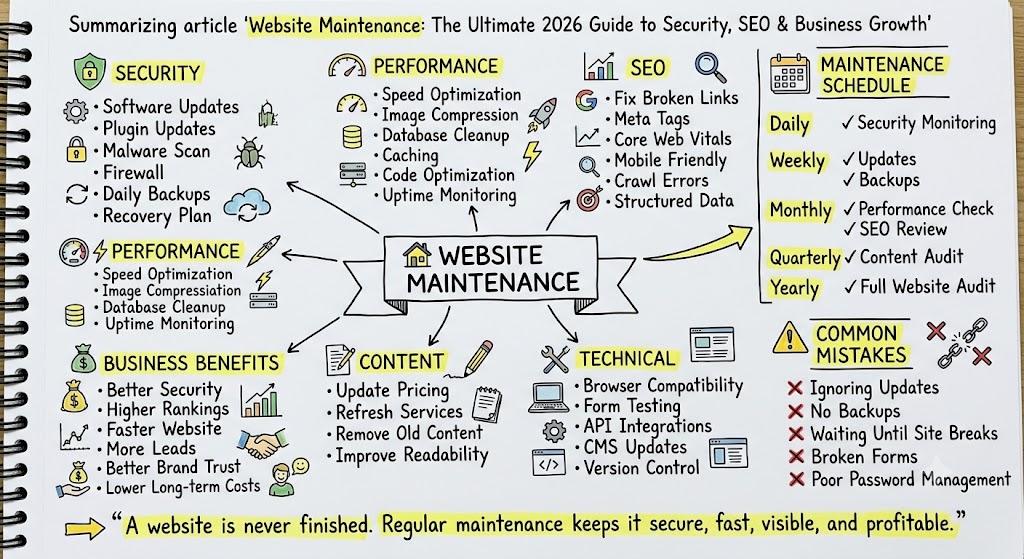
To truly understand what is website maintenance, we need to look beyond the dictionary definition. It is not merely about fixing broken links or updating plugins. It is a strategic, ongoing commitment to your digital asset. Think of your website as a physical storefront. You wouldn’t build a store, stock it with products, and then never clean it, fix a leaky roof, or update the signage. Similarly, your website requires constant care to remain inviting, functional, and secure for your visitors.
When we talk about website maintenance, we are referring to a spectrum of activities that can be broadly categorized. It involves ensuring the maintenance of the website from a technical standpoint, but also from a content and user experience perspective. It is the maintenance of website health that ensures your online presence supports your business objectives, rather than hindering them.
Many business owners ask, “Why is website maintenance necessary?” The simple answer is that the digital landscape is not static. Search engine algorithms change, new security vulnerabilities are discovered daily, and user expectations evolve. Without proactive site maintenance, your website becomes outdated, insecure, and less effective, costing you leads, sales, and credibility.
Despite its critical importance, website maintenance is frequently neglected. This oversight often stems from a lack of understanding or a short-term view of costs. Many businesses treat websites as one-time projects. Once the site is launched, attention shifts to marketing or operations. This approach creates hidden risks that can be catastrophic.
Several factors contribute to the neglect of website maintenance:
In reality, neglecting website maintenance often results in higher costs later due to emergency fixes, data loss, or security incidents. The cost of a reactive fix is almost always higher than proactive website maintenance.
Website maintenance is not a single task. It is a structured set of ongoing activities performed at regular intervals. Understanding these components is the first step in appreciating the value of a comprehensive maintenance plan.
Here are the critical components that define what web maintenance actually entails:
Each of these components plays a specific role in ensuring website stability and long-term success. A robust website maintenance services plan addresses all of these areas.
Website maintenance is not just a technical chore; it’s a strategic business function. It aligns your digital presence with your business goals, protects your brand, and drives growth.
It transforms a website from a static asset into a reliable growth platform. This is the core reason why website maintenance is necessary for any serious business.
Understanding the different types of website maintenance helps you build a comprehensive strategy. It’s not just about fixing what’s broken; it’s about continuously improving and adapting.
This is the most proactive and cost-effective form of site maintenance. It involves activities performed to prevent issues before they occur. This includes regular software updates, security scans, and performance monitoring.
This is the reactive form of maintenance website. It involves fixing bugs, errors, or broken functionality when they are detected. While necessary, corrective maintenance is often more expensive and disruptive than preventive maintenance.
This type of maintenance focuses on updating the website to remain compatible with new technologies, browsers, or devices. As the digital ecosystem evolves, your website must adapt to stay functional. This is a crucial part of website hosting and maintenance.
This goes beyond fixing and adapting. Perfective maintenance involves improving features, usability, and performance based on analytics, user feedback, and business needs. It’s about making your website better over time.
A comprehensive website maintenance strategy includes all four types. This ensures your site is not only secure and functional but also continuously improving.
Security is the most critical reason website maintenance is necessary. The internet is a dangerous place, and websites face constant threats. Neglecting security website maintenance is like leaving the front door of your business unlocked in a high-crime area.
Websites face a myriad of threats, including:
Outdated plugins, themes, or CMS versions are the most common entry points for attackers. When a vulnerability is discovered, attackers will immediately start scanning the web for sites that haven’t patched it. This is why regular website updates and maintenance are so vital.
A robust website maintenance plan provides a multi-layered defense:
A single security breach can damage brand trust, lead to financial loss, and even result in legal consequences. Investing in web maintenance services is an investment in the security and longevity of your business.
Performance is a critical factor in the success of your website. It directly impacts user experience, conversion rates, and search engine rankings. Performance optimization is a core component of website maintenance.
Slow websites lead to:
Website maintenance ensures your site runs at peak performance through a variety of tasks:
Regular performance website maintenance ensures the site remains efficient as content and traffic grow.
Search engines constantly update their algorithms. Websites that are not maintained fall behind. Website maintenance plays a crucial role in maintaining and improving your search engine rankings.
Website maintenance supports SEO in several key ways:
Without maintenance, even well-optimized content will lose visibility over time. This is why website maintenance and support is so crucial for long-term SEO success.
To fully understand what website maintenance is and why it is necessary, it is important to examine the individual tasks involved. Website maintenance is not a vague technical service. It is a structured set of activities, each with a clear purpose and business impact.
What This Task Involves: Updating the core CMS, themes, plugins, and testing updates in a staging environment.
Why It Is Necessary: Outdated software is the number one cause of website hacks. Updates include security patches, performance improvements, and compatibility fixes.
Key Activities: Malware scanning, firewall configuration, spam protection, login attempt monitoring, and file integrity checks.
Business Impact: A compromised website can result in stolen data, search engine blacklisting, loss of customer trust, and legal consequences.
What Backup Maintenance Includes: Automated daily/weekly backups, secure off-site storage, regular backup testing, and fast recovery procedures.
Why Backups Are Critical: If a website crashes, is hacked, or data is accidentally deleted, backups allow rapid restoration.
Performance Maintenance Includes: Image compression, database cleanup, caching configuration, code optimization (minification), and server resource monitoring.
Why Performance Maintenance Matters: Slow websites increase bounce rates and reduce conversions. Search engines also prioritize fast loading websites.
Common Issues: Broken internal links, external links leading to removed pages, 404 and 500 errors, and form submission failures.
Why This Task Is Necessary: Broken links harm user experience and SEO. Error monitoring ensures visitors can navigate the site smoothly.
Compatibility Maintenance Includes: Testing on major browsers, checking mobile and tablet layouts, and ensuring form and script functionality.
Business Impact: A website that works only on certain devices frustrates users and loses potential customers.
Content Maintenance Tasks: Updating service descriptions, refreshing pricing, fixing outdated information, and improving readability.
Why Content Maintenance Is Important: Outdated content damages credibility and trust. Accurate content improves user confidence and conversion rates.
SEO Maintenance Activities: Fixing crawl and index issues, updating meta tags, monitoring Core Web Vitals, and maintaining structured data.
Why SEO Maintenance Is Necessary: Search engine algorithms evolve continuously. Websites that are not maintained gradually lose rankings.
What Needs Regular Testing: Contact forms, email notifications, CRM integrations, and third-party APIs.
Business Impact: A broken form means lost leads. Functional testing ensures business processes continue without interruption.
Uptime Maintenance Includes: Server availability monitoring, alert systems for downtime, and quick response procedures.
Why It Matters: Even a few hours of downtime can result in lost revenue, especially for service and ecommerce websites.
Maintenance Documentation Includes: Record of updates, version tracking, and access management.
Long Term Benefit: Documentation reduces dependency on specific individuals and makes future updates faster and safer.
Understanding what website maintenance includes is only half the picture. The real value becomes clear when examining how regular maintenance directly benefits the business, search visibility, and user experience.
Revenue Risks of Poor Maintenance: Broken contact forms result in lost inquiries, slow loading pages reduce conversion rates, downtime interrupts sales, and security breaches cause customer distrust.
How Maintenance Helps: Regular website maintenance minimizes these risks and ensures revenue channels remain uninterrupted.
Credibility Signals: Fast page load times, error-free navigation, updated content, and secure browsing all signal professionalism.
Result: A well-maintained website reinforces professionalism, reliability, and trustworthiness.
Cost Comparison: Minor update issues fixed early cost very little. Major failures caused by neglect require extensive fixes. Security breaches can cost thousands in cleanup and recovery.
Conclusion: Website maintenance is a cost-saving strategy when viewed over the long term.
How Maintenance Creates Advantage: Faster websites outperform slower competitors, secure websites build stronger trust, and up-to-date content improves authority.
Result: Many competitors neglect website maintenance, making consistent upkeep a subtle but powerful differentiator.
Maintenance Enables Marketing Success: Landing pages load correctly during campaigns, tracking scripts function accurately, and analytics data remains reliable.
Risk Without Maintenance: Without website maintenance, marketing investments can be undermined by technical issues.
Compliance Benefits: Regular maintenance allows for timely updates for privacy requirements, accessibility improvements, and secure data handling.
Result: Regular website maintenance reduces legal and compliance risks.
Maintenance Prepares for Growth: A clean codebase supports new features, updated systems integrate easily with tools, and scalable infrastructure remains stable.
Conclusion: Website maintenance ensures the website can evolve without major rework.
Understanding website maintenance costs is crucial for budgeting. The cost varies significantly based on location, site complexity, and the service type.
The table below shows typical monthly costs for a small business website maintenance plan in USD.
| Region | Entry Level (Basic) | Mid Tier (Professional) | Premium/Enterprise |
|---|---|---|---|
| United States | $200 – $400 | $500 – $1,200 | $1,200 – $2,500+ |
| United Kingdom | $190 – $380 | $380 – $1,000 | $1,000 – $1,900+ |
| UAE | $220 – $410 | $410 – $820 | $820 – $1,650+ |
| India | $40 – $100 | $100 – $250 | $250 – $600+ |
| Philippines | $90 – $180 | $180 – $360 | $360 – $540+ |
| Australia | $200 – $330 | $330 – $660 | $660 – $1,320+ |
| Canada | $190 – $340 | $340 – $680 | $680 – $1,360+ |
| Germany | $220 – $380 | $380 – $820 | $820 – $1,640+ |
| Brazil | $90 – $180 | $180 – $450 | $450 – $900+ |
| South Africa | $140 – $280 | $280 – $560 | $560 – $1,120+ |
The complexity of your site is the biggest cost driver. Here’s a breakdown by site type:
| Site Type | Typical Monthly Cost (USD) | Key Requirements |
|---|---|---|
| Personal Blog/Portfolio | $0 – $50 | Often covered by managed hosting; minimal updates needed. |
| Small Business Website | $100 – $300 | Includes updates, security monitoring, and basic support. |
| Business/Membership Site | $150 – $500+ | Adds staging environment testing and more developer hours. |
| E-commerce (WooCommerce/Shopify) | $300 – $1,000+ | Highest cost due to revenue risk, complex plugin ecosystems, and stricter security needs. |
| Custom Web Application | $1,000 – $3,000+ | Requires specialized developers, continuous integration, and advanced security. |
| Corporate/Enterprise Site | $500 – $2,000+ | High traffic, complex integrations, and strict SLA requirements. |
Maintenance plans bundle multiple tasks into a predictable monthly cost.
| Service | Basic Plan | Standard Plan | Advanced Plan |
|---|---|---|---|
| CMS/Plugin Updates | Monthly | Weekly | Daily (as needed) |
| Security Monitoring | Basic (weekly scans) | Advanced (daily scans) | Real-time monitoring |
| Backups | Weekly | Daily | Real-time |
| Performance Optimization | Quarterly | Monthly | Weekly |
| Content Updates | Limited (1-2 hrs/month) | Included (3-5 hrs/month) | Unlimited (within reason) |
| Uptime Monitoring | Yes | Yes | Yes (with SLA) |
| Priority Support | No | Business Hours | 24/7 |
| Staging Environment | No | Yes | Yes |
| SEO Health Checks | Quarterly | Monthly | Weekly |
Businesses can manage website maintenance internally or outsource it. Each approach has its pros and cons.
Pros: Direct control, immediate access.
Cons: Requires technical expertise, higher long-term cost, resource dependency.
Pros: Predictable costs, access to specialists, reduced internal workload.
Cons: Requires choosing a reliable provider, less direct control.
For most businesses, outsourcing website maintenance to a specialized provider is more cost-effective and reliable than maintaining an in-house team.
Website maintenance is not a one-time task. It’s an ongoing process. Consistency is more important than intensity.
Even businesses that understand the importance of website maintenance often execute it poorly.
Reactive website maintenance is the most expensive approach. Waiting for errors, downtime, or security issues before taking action leads to rushed fixes and higher costs.
Some businesses avoid updates because they fear compatibility issues. Outdated systems are more dangerous than updated ones. Proper testing and staging environments eliminate this risk.
Many websites have backups, but they are never tested. Backups may be incomplete or corrupted. Backups must be tested regularly to ensure reliability.
Website maintenance is often scheduled once and forgotten. Technology evolves continuously, security threats change daily, and search engine standards shift frequently.
Over time, multiple users gain access to the website. This creates risks of unauthorized changes, security vulnerabilities, and difficulty tracking issues.
Businesses that manage website maintenance well follow structured, repeatable processes.
A documented checklist ensures no critical task is missed. Typical areas: updates and security, backups, performance checks, SEO health, and content accuracy.
Automated monitoring reduces human dependency. Benefits: immediate downtime alerts, early detection of performance drops, and faster issue resolution.
Testing updates on a staging site prevents live issues. Advantages: safe updates, controlled testing, and reduced downtime.
Website maintenance should be part of routine operations. Recommended cadence: weekly technical checks, monthly performance and SEO reviews, and quarterly content audits.
Every update should be recorded. Benefits: faster troubleshooting, clear accountability, and easier onboarding of new team members.
To rank for a broad term like “website maintenance,” you must build topical authority. This means covering the topic comprehensively across your entire site.
Topical authority is when search engines recognize your site as the expert source on a specific subject, not just for individual keywords, but for the full range of related queries. This is achieved through:
Websites with strong topical authority are more resilient to algorithm updates and can rank for a wider range of related searches. This is why a comprehensive, long-form guide like this is so valuable.
Website maintenance is no longer just technical upkeep. It’s adapting to new trends and technologies.
Businesses that adapt to these trends reduce risk and gain competitive advantage.
Ultimately, the responsibility for website maintenance falls on the business owner. However, it can be delegated in various ways.
Options include:
For businesses that rely heavily on their digital presence, partnering with an experienced agency ensures consistent website maintenance, proactive monitoring, and long-term reliability without internal overhead.
Website maintenance is the foundation of a reliable, secure, and high-performing online presence. It ensures that a website continues to support business goals long after launch.
Organizations that invest in regular, structured website maintenance avoid disruption, reduce costs, and build lasting trust with users. In a digital environment that changes constantly, website maintenance is not optional, temporary, or secondary. It is a continuous responsibility that determines whether a website remains an asset or becomes a liability.
By avoiding common mistakes, following best practices, and planning for the future, businesses can ensure their website remains strong, relevant, and effective for years to come.
Website maintenance typically refers to the proactive, routine tasks needed to keep a site running smoothly, such as updates, security scans, and backups. Website support is often more reactive, helping with specific issues, troubleshooting, and answering user questions.
Website maintenance is the set of ongoing tasks required to keep a website functioning optimally. This includes updating software, monitoring security, backing up data, optimizing performance, and ensuring content accuracy.
Yes, absolutely. Without regular site maintenance, your website becomes vulnerable to security threats, performance issues, and outdated content. This can lead to lost traffic, lower search rankings, and a damaged brand reputation.
The cost of web maintenance services varies widely. For a small business site, you can expect to pay anywhere from $100 to $500 per month. See our pricing tables above for a detailed breakdown.
A comprehensive website maintenance plan typically includes software updates, security monitoring, regular backups, performance optimization, content updates, and uptime monitoring.
Website maintenance is the process of keeping your website secure, up-to-date, and performing well. It is necessary because the digital world is constantly changing. Without it, your site becomes outdated, insecure, and less effective.
Review your core content (like “About Us,” “Services,” and “Contact” pages) at least quarterly. Blog posts and news updates should be published as often as you have valuable information to share.
A staging environment is a clone of your live website used for testing. It allows you to test updates, new features, or design changes in a safe, private space before pushing them live.
For more information on professional website maintenance solutions, or to get a custom quote for your specific needs, please contact Abbacus Technologies today.

Get cost, timeline & technical suggestions within 24 hours.




