
- We offer certified developers to hire.
- We’ve performed 1500+ Web/App/eCommerce projects.
- Our clientele is 1000+.
- Free quotation on your project.
- We sign NDA for the security of your projects.
- Three months warranty on code developed by us.
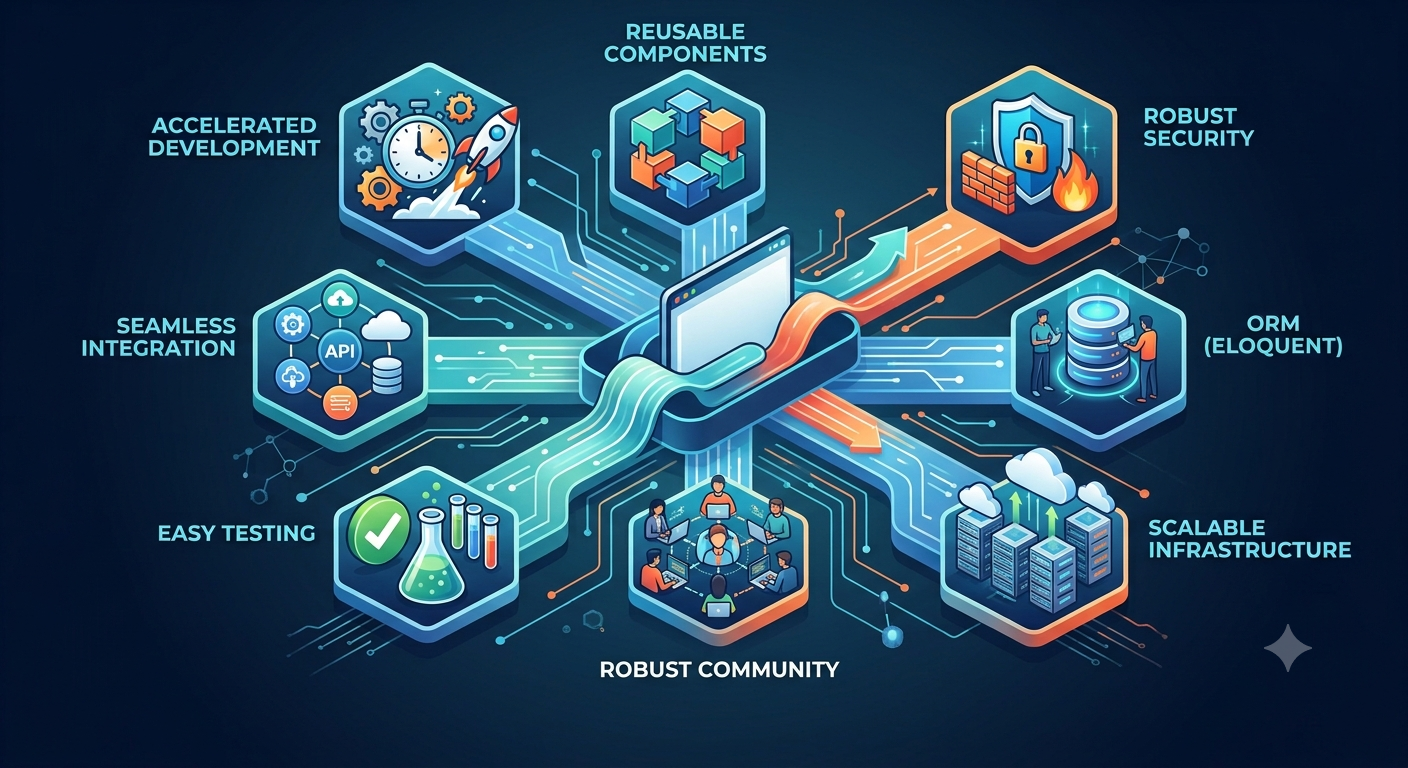
In today’s fast-paced digital environment, businesses require more than just a basic website or off-the-shelf software to remain competitive. The increasing demand for personalized user experiences, streamlined workflows, and seamless integrations has made custom applications not just a trend, but a necessity. At the heart of many successful custom web application projects lies a powerful, elegant PHP framework: Laravel. In this first part of our comprehensive exploration, we delve into what Laravel is, why it has become the preferred choice for developers worldwide, and how it aligns perfectly with the goals of building scalable, maintainable, and future-proof custom applications in 2026 and beyond.
Laravel is an open-source PHP framework created by Taylor Otwell in 2011. It was designed to simplify complex coding tasks and offer a cleaner, more readable syntax that empowers developers to build robust web applications with remarkable speed. Laravel follows the Model-View-Controller (MVC) architectural pattern, making it easier to separate logic, presentation, and data, which significantly enhances maintainability and scalability in applications of all sizes.
Since its launch, Laravel has rapidly gained traction among developers for its developer-centric tools and vibrant ecosystem. It offers an array of built-in functionalities, including routing, templating, authentication, caching, and session management, all of which are essential for developing robust and secure web applications. As of 2026, Laravel powers over a million websites globally and continues to be the framework of choice for startups, agencies, and enterprises alike.
The modern business landscape is highly competitive, where generic software can no longer cater to the specific needs of every business. Organizations often require:
Off-the-shelf solutions often fall short in addressing these specialized requirements. They force businesses to adapt their processes to the software, rather than the software adapting to them. This is where custom application development comes into play—offering flexibility, adaptability, and better control over the development lifecycle.
Laravel stands out among PHP frameworks as the go-to choice for developing custom web applications due to the following reasons:
Laravel’s adherence to the MVC architecture provides several benefits when creating custom applications:
This architecture is particularly useful when building complex custom applications where modularity and reuse of components are vital for long-term sustainability.
Laravel isn’t just a framework—it’s an entire ecosystem. Some of its popular ecosystem tools that aid in custom application development include:
These tools enable developers to manage infrastructure, back-end logic, and front-end assets efficiently, offering a holistic environment for end-to-end custom application development.
When developing custom applications, security is a top concern. Laravel comes equipped with strong security features:
For businesses handling sensitive data—be it financial, healthcare, or personal information—these features provide a secure foundation upon which to build.
Custom applications often require complex data models. Laravel’s Eloquent ORM (Object Relational Mapper) allows developers to interact with databases using simple, expressive syntax. This not only speeds up development but also reduces the chances of errors in SQL logic.
Eloquent supports:
These features empower developers to craft intricate data relationships without writing convoluted SQL, making data handling in custom applications smooth and logical.
In an increasingly globalized market, many businesses need applications that cater to different languages and regions. Laravel supports localization, allowing developers to build multilingual applications by storing strings in various languages in separate files. With Laravel, developers can dynamically switch languages based on user preferences or location, enhancing user experience in diverse markets.
Laravel is built with testing in mind. The framework supports PHPUnit out of the box and provides helper methods to simulate user actions and verify application behavior. For custom applications that must go through multiple quality assurance stages, Laravel’s testing tools ensure reliability and robustness.
Laravel supports:
This testability ensures that every component of a custom application performs as intended before it ever goes live.
Custom applications often begin as small projects that evolve into larger, enterprise-level solutions. As user demands and data volumes grow, so must the application. This is where scalability and performance become crucial, along with the ability to integrate seamlessly with third-party services and internal systems. Laravel, with its advanced architectural components and optimized development ecosystem, provides a strong foundation for scalable, high-performance applications that can be integrated flexibly into any digital environment in 2026.
The success of a custom application hinges not only on its current functionality but also on how well it can scale. Laravel is inherently structured to accommodate growth in three primary ways:
Laravel encourages a modular approach to coding by organizing features into self-contained service providers. As the application grows, developers can split it into smaller modules without refactoring the entire codebase. This modularity is particularly useful in large applications that require the addition of new features over time.
Laravel’s queue system enables deferred processing of time-consuming tasks like sending emails, processing uploads, or making external API requests. By offloading such tasks to queues, Laravel ensures a responsive experience for users, even when the application is under heavy load.
It supports queue backends like:
With the Horizon dashboard, you can easily monitor and manage these queues, ensuring optimal job performance.
Laravel supports RESTful API development out of the box, and with Laravel Lumen (a lightweight version), it also becomes a strong candidate for microservices architecture. You can decouple services and scale individual parts of the system independently, which is perfect for SaaS products or large-scale enterprise systems.
While Laravel is a feature-rich framework, it’s also performance-aware. Here are several ways Laravel helps in optimizing performance:
Laravel provides the ability to cache routes, drastically speeding up route registration during application startup.
php artisan route:cache
This command compiles all routes into a single method call, which is faster than parsing individual routes on every request.
Laravel allows configuration and view files to be compiled and cached using Artisan commands. This minimizes file system access and speeds up the application’s response time.
php artisan config:cache
php artisan view:cache
Laravel’s Eloquent ORM provides tools for eager loading data relationships, avoiding the notorious N+1 query problem. Developers can selectively retrieve related models in a single query, improving database performance.
Example:
$users = User::with('posts')->get();
By combining Laravel with OPcache, developers can ensure that PHP scripts are compiled and cached in memory. Paired with optimized deployment tools like Laravel Forge or Envoyer, performance bottlenecks can be minimized significantly.
Laravel supports various caching systems that play a huge role in performance:
With these, developers can cache frequently used data, configuration files, API responses, and even entire database queries.
Similarly, Laravel supports session storage via:
This flexibility ensures applications perform well regardless of infrastructure setup.
Modern applications rarely exist in isolation. Whether it’s payment gateways, CRMs, ERP systems, or third-party APIs, custom applications often need to communicate with external services. Laravel provides excellent tools for this.
Laravel introduced an expressive, fluent interface for HTTP requests via the Http facade. It simplifies calling external APIs and handling responses, with built-in support for:
Example:
$response = Http::withHeaders(['Authorization' => 'Bearer '.$token,])->get('https://api.example.com/users');
Custom applications that need real-time updates or third-party webhook handling can use Laravel’s Event Broadcasting system. It allows seamless communication with technologies like Pusher, Ably, or WebSockets, ensuring real-time updates like chat, notifications, or live feeds.
Laravel offers two major tools for securing and authenticating APIs:
These packages allow your custom application to securely expose APIs for third-party integrations or client-facing services.
Laravel supports all major relational databases including MySQL, PostgreSQL, SQLite, and SQL Server. Its migration system and seeder classes allow teams to manage schema versions and test datasets easily, which is vital when evolving a custom solution.
In addition, Laravel supports:
All of these are essential when building custom applications that rely on non-standard or legacy data structures.
Middleware in Laravel allows you to insert logic before or after requests are handled. Custom applications often need business logic applied to requests—such as API key validation, request throttling, or permission filtering.
Laravel makes this seamless by letting you define your own middleware stack for any route or group of routes.
Example:
Route::group(['middleware' => ['auth', 'role:admin']], function () { Route::get('/dashboard', [DashboardController::class, 'index']); });
This gives developers full control over the request lifecycle, a must for enterprise-grade or B2B custom apps.
Laravel’s Task Scheduling system allows developers to define scheduled tasks within the application, avoiding complex cron job setups.
Example from App\Console\Kernel.php:
$schedule->command('emails:send')->dailyAt('08:00');
For custom applications that require regular maintenance tasks, reporting, alerts, or system health checks, this feature is invaluable.
When developing a custom application, it’s not just about backend functionality. User experience (UX), visual interface design, and rapid development are equally critical for user retention, client satisfaction, and iterative growth. Laravel shines in these areas by providing flexible tools and structures that help developers seamlessly blend robust backend logic with dynamic, interactive frontend interfaces. This part explores how Laravel supports frontend integration, accelerates prototyping, and delivers a polished user experience in custom software projects.
At the heart of Laravel’s frontend rendering is Blade, its powerful and intuitive templating engine. Blade allows developers to build complex interfaces using clean and readable syntax. Unlike traditional PHP, Blade separates logic and HTML effectively, enhancing maintainability.
Example:
@extends('layouts.app')
@section('content')
<h1>Welcome, {{ $user->name }}</h1>
@if($user->isAdmin())
<p>You have admin access.</p>
@endif
@endsection
This capability is crucial for creating custom application UIs that are consistent, fast to develop, and easy to maintain.
Laravel is frontend-agnostic, meaning it integrates well with various frontend technologies. Whether you’re building a simple interactive form or a full single-page application (SPA), Laravel’s ecosystem supports it.
Laravel used to ship with Vue by default, and many developers continue to use it because:
Laravel also supports Inertia.js, which allows developers to build SPAs without an API. It bridges Laravel + Vue/React so developers can use controllers and routes like traditional apps while gaining SPA performance.
React can be easily set up using Laravel Mix, and is ideal for applications needing a more component-heavy or JS-centric approach.
For developers who prefer lightweight JavaScript, Laravel promotes Alpine.js—a minimalist JS framework that allows dynamic behavior without full SPA complexity. It’s perfect for toggles, tabs, and interactivity in simpler custom applications.
Laravel Mix is a wrapper around Webpack, simplifying asset compilation and versioning. It helps developers compile SCSS, JavaScript, Vue/React components, and even TailwindCSS efficiently.
Example from webpack.mix.js:
mix.js('resources/js/app.js', 'public/js')
.sass('resources/sass/app.scss', 'public/css')
.version();
This is particularly valuable when building custom applications where branding and performance optimizations (like minification and caching) matter.
Livewire is a Laravel-specific package that lets developers build dynamic interfaces using PHP—no JavaScript required. This is revolutionary for teams that are backend-heavy or want to prototype interactive features quickly.
Livewire enables:
Example use case:
<div>
<input wire:model="search" type="text" placeholder="Search users...">
<ul>
@foreach($results as $user)
<li>{{ $user->name }}</li>
@endforeach
</ul>
</div>
Livewire automatically handles state updates between client and server, perfect for custom admin panels and CRM interfaces.
For startups or innovation teams, the ability to build a Minimum Viable Product (MVP) quickly can make or break the entire business idea. Laravel makes MVP development fast and efficient due to:
Laravel’s command-line tool, Artisan, speeds up development by automating repetitive tasks.
Examples:
php artisan make:model Product -mcr
php artisan make:auth
These commands generate models, migrations, controllers, and routes instantly, saving hours of manual setup.
Laravel allows you to version control your database schema and populate test data quickly—key when validating MVP concepts.
Laravel offers starter kits that handle common user-facing features like:
These kits allow developers to hit the ground running without re-building authentication or session logic.
Laravel facilitates good UX in custom applications through:
Example:
return redirect()->route('dashboard')->with('success', 'Profile updated successfully!');
Laravel’s form validation system also enhances UX by showing user-friendly error messages and maintaining form inputs upon submission.
Custom business applications often require complex internal interfaces. Laravel supports this need through:
These admin panels help businesses manage users, content, workflows, reports, and analytics efficiently.
Laravel applications can be easily converted into Progressive Web Apps (PWAs). Using packages like laravel-pwa, developers can make their web apps:
This is a big plus for businesses wanting mobile-ready custom applications without the cost of full mobile app development.
Laravel makes it easier to adhere to web accessibility and compliance standards (like GDPR and ADA) by allowing:
Custom applications, especially in sectors like healthcare, education, or finance, benefit significantly from Laravel’s flexible compliance handling.
As custom applications grow in scale and complexity, the sustainability of the codebase becomes critical. Security, maintainability, collaboration, and version control are essential components of long-term success in custom software development. Laravel stands out in these areas, offering tools and best practices that help developers build secure, well-structured, and team-friendly applications from day one. In this section, we’ll explore Laravel’s advantages in these domains and how they contribute to the longevity and quality of custom-built software solutions.
Laravel places security at the center of its design. For custom applications dealing with sensitive data or financial transactions, this built-in protection is invaluable.
Laravel automatically escapes output in Blade templates. This means that user-generated content (e.g., comments, form input) is sanitized to prevent malicious script injection.
{{ $comment->body }} // automatically escaped
Laravel uses CSRF tokens for all POST, PUT, DELETE requests. This token validation prevents unauthorized actions from being performed on behalf of users.
<form method="POST"> @csrf </form>
Laravel’s Eloquent ORM and Query Builder use parameter binding, which prevents attackers from injecting harmful SQL commands.
DB::table('users')->where('email', $email)->get(); // Secure
Laravel comes with pre-built scaffolding for user authentication and offers fine-grained authorization via Gates and Policies. This ensures only authorized users access sensitive actions.
Laravel uses Bcrypt and Argon2 for password hashing, and the built-in Crypt class allows encryption of data using OpenSSL.
$encrypted = Crypt::encryptString('sensitive-data');
$decrypted = Crypt::decryptString($encrypted);
Laravel provides built-in rate limiting, essential for preventing brute-force attacks or API abuse.
Route::middleware(['throttle:60,1'])->group(function () { // Routes limited to 60 requests per minute });
Laravel encourages clean code through its architecture, conventions, and tooling.
The Model-View-Controller (MVC) structure allows a clear separation of concerns:
This separation makes code easier to debug, maintain, and refactor over time.
Laravel’s Service Container allows you to manage class dependencies and perform dependency injection, making your code loosely coupled and testable.
public function __construct(UserRepositoryInterface $repo) { $this->repo = $repo; }
This structure promotes reusable and clean code, especially in large custom systems.
Laravel provides facades as elegant syntactic shortcuts for commonly used classes. While some criticize facades for hiding dependencies, Laravel allows developers to swap between facades and dependency injection easily.
Example:
Cache::put('key', 'value', 600);
For complex business logic, Laravel supports Service Classes, Jobs, and Command Buses to encapsulate logic away from controllers, keeping controllers thin and readable.
Team development is often essential for custom applications, and Laravel supports collaboration by design.
Laravel adheres to PSR-12 coding standards, ensuring consistent code across teams. With tools like PHP-CS-Fixer or Laravel Pint, developers can automatically enforce style rules.
Laravel’s migration system allows multiple developers to work on the database without conflicts. Version-controlled migrations ensure each environment (dev, staging, prod) stays in sync.
php artisan migrate
php artisan migrate:rollback
Factories and seeders allow developers to create dummy data for testing or demo purposes, crucial in collaborative environments.
User::factory()->count(10)->create();
This ensures all team members can work with identical datasets.
Laravel supports modular architecture. You can build packages or internal modules for reusable components—helping teams work independently on isolated features without conflict.
Laravel projects are inherently Git-friendly. The folder structure is clean, and sensitive files like .env are excluded by default, allowing secure and smooth version control practices.
Laravel is built for test-driven development (TDD) and comes with robust testing tools.
Laravel comes pre-configured with PHPUnit, allowing for:
Laravel provides helpers to test HTTP endpoints quickly.
$response = $this->get('/dashboard');
$response->assertStatus(200);
With Laravel’s Service Container, you can mock dependencies for unit tests easily, making it ideal for writing isolated and reliable tests.
Test data can be generated quickly using model factories, and Laravel can wrap each test in a transaction that rolls back after execution—keeping tests clean.
Laravel uses .env files for environment configuration. This separates your code from configuration, allowing different setups for development, staging, and production.
APP_NAME=MyApp
APP_ENV=local
APP_KEY=base64:xxxxxxx
DB_CONNECTION=mysql
This setup makes deployments more predictable and secure—critical in custom applications where different environments need specific setups.
Laravel supports smooth CI/CD integration and DevOps workflows:
These tools help developers automate deployment pipelines and reduce production risks.
By now, it’s clear that Laravel is more than just a web framework—it’s an ecosystem that provides everything needed to build modern, scalable, secure, and maintainable custom applications. In this final part, we will explore how Laravel is used in real-world business scenarios, highlight industry-specific solutions, and explain why businesses across the globe are choosing Laravel to power their mission-critical applications.
Businesses opt for Laravel when they need:
Laravel provides this with minimal overhead, making it ideal for startups, SMEs, and even large enterprises. It allows businesses to build exactly what they need, rather than adapting to the limitations of off-the-shelf software. Companies like Abbacus Technologies specialize in leveraging Laravel to deliver custom solutions that drive business growth and operational efficiency.
Laravel has become a popular choice for custom ecommerce platforms, especially when businesses want features that platforms like Shopify or WooCommerce can’t provide out of the box.
Features Laravel powers in ecommerce:
Popular Example: Bagisto – an open-source ecommerce platform built on Laravel.
Laravel is often used as the backend engine for SaaS (Software-as-a-Service) products. Its flexibility and API capabilities make it a solid choice for building scalable SaaS platforms.
SaaS features powered by Laravel:
Why Laravel for SaaS? It enables MVP development quickly and scales easily as the product gains traction.
Laravel is used in the healthcare industry to build secure, compliant, and highly customized platforms such as:
Security is critical in this domain, and Laravel’s CSRF protection, data encryption, and fine-grained access control make it HIPAA-compliant when combined with proper infrastructure and policies.
Laravel is often used to create LMS (Learning Management Systems) and educational portals. These are used by schools, training organizations, and e-learning startups.
Key features developed using Laravel:
Open-source Example: Attendize – a Laravel-based ticketing and event platform, often used in educational events and webinars.
Many companies build custom ERP and CRM systems using Laravel to support unique workflows that generic software can’t accommodate.
Modules in a Laravel-based ERP/CRM:
With Laravel’s modular structure, these large-scale systems can be built incrementally and customized for each department.
Startups favor Laravel for its rapid development capabilities, which allow them to quickly bring MVPs to market. Laravel’s built-in features (auth, routing, testing, queues) reduce the need for external libraries and speed up development.
Startups also benefit from:
Enterprises value Laravel for:
Laravel is often used alongside enterprise tools (like SAP or Salesforce) via APIs and queues to build dashboards, portals, or middleware layers.
Here are examples of how Laravel powers real-world solutions:
These examples show Laravel’s versatility across sectors.
Laravel’s ecosystem is a big reason why companies trust it for custom application development.
This ecosystem allows custom applications to grow from simple MVPs to production-grade platforms without leaving Laravel’s stack.
Laravel also benefits development teams and agencies that manage multiple custom application projects:
For agencies, Laravel reduces both development time and post-launch maintenance costs, increasing client satisfaction and profitability.
Laravel is actively maintained, with regular version updates, long-term support (LTS) versions, and a vast roadmap ahead. The Laravel community and ecosystem ensure that:
The framework continues to evolve, integrating the latest trends like Livewire, Inertia, serverless architecture, and headless development.
In the evolving landscape of digital innovation, the need for custom applications has never been greater. Off-the-shelf solutions often fall short in addressing the nuanced requirements of modern businesses—from unique workflows and data models to specialized security standards and performance expectations. Laravel emerges as a clear leader among PHP frameworks, offering not only robust technical capabilities but also a developer-friendly environment that accelerates innovation and ensures long-term maintainability.
Through the five parts of this article, we’ve explored how Laravel empowers custom development by offering:
Whether you’re a startup launching your first MVP, a scaling SaaS platform managing thousands of users, or an enterprise building internal tools that need high performance and security—Laravel offers the reliability, agility, and elegance needed for success.
Laravel is not just a framework—it’s a well-supported and actively evolving ecosystem that reduces complexity, improves developer productivity, and delivers exceptional results for businesses investing in custom software. With a strong global community, comprehensive documentation, and regular innovation cycles, Laravel continues to lead the way as the framework of choice for modern, tailor-made web applications.
If your goal is to build a scalable, secure, and user-centric digital product that evolves with your business, then Laravel is not just a good option—it’s the smart choice.

Get cost, timeline & technical suggestions within 24 hours.




